You Clicked on our Bag or ad.
Scroll down for more Info.
Welcome to Authentic Origin Spices.
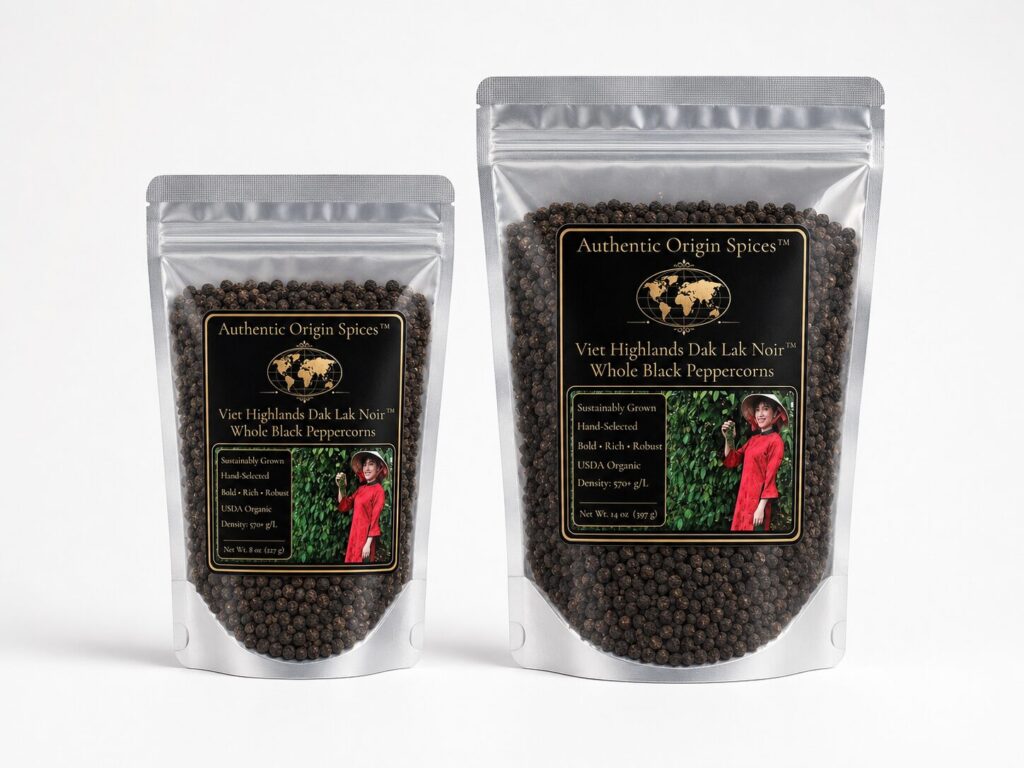
You likely arrived here by scanning the QR code on a bag of Viet Highlands Dak Lak Noir™ Black Peppercorns or an ad. Explore the story behind these peppercorns, learn about their origin and character, and find the best way to enjoy them.
Ready to order or restock? Use the links below to purchase directly from our website
or through your preferred online marketplace, including Amazon, Etsy, eBay or the TikTok shop with these buttons below.
How I found Viet Highlands Dak Lak Noir™ Black Peppercorns
I did not discover Viet Highlands Dak Lak Noir™—I created it. After visiting Vietnam’s Đắk Lắk region, tasting peppercorns from different areas, researching suppliers, and examining origin documentation, I found that many products marketed in the United States simply as “Vietnamese pepper” could not be traced with confidence to a specific Vietnamese growing region. Some supplier specifications even identify multiple possible countries of origin, including Vietnam, India, Indonesia, and Brazil. I wanted something more exact: a truly single-region Vietnamese peppercorn, sourced from farms whose sustainability practices could be meaningfully verified and that met the standards I required, including Rainforest Alliance–aligned practices. Viet Highlands Dak Lak Noir™ is the result—a pepper selected for its documented origin, responsible cultivation, and distinctive character from Vietnam’s Central Highlands.
Farm Visits in Dak Lak
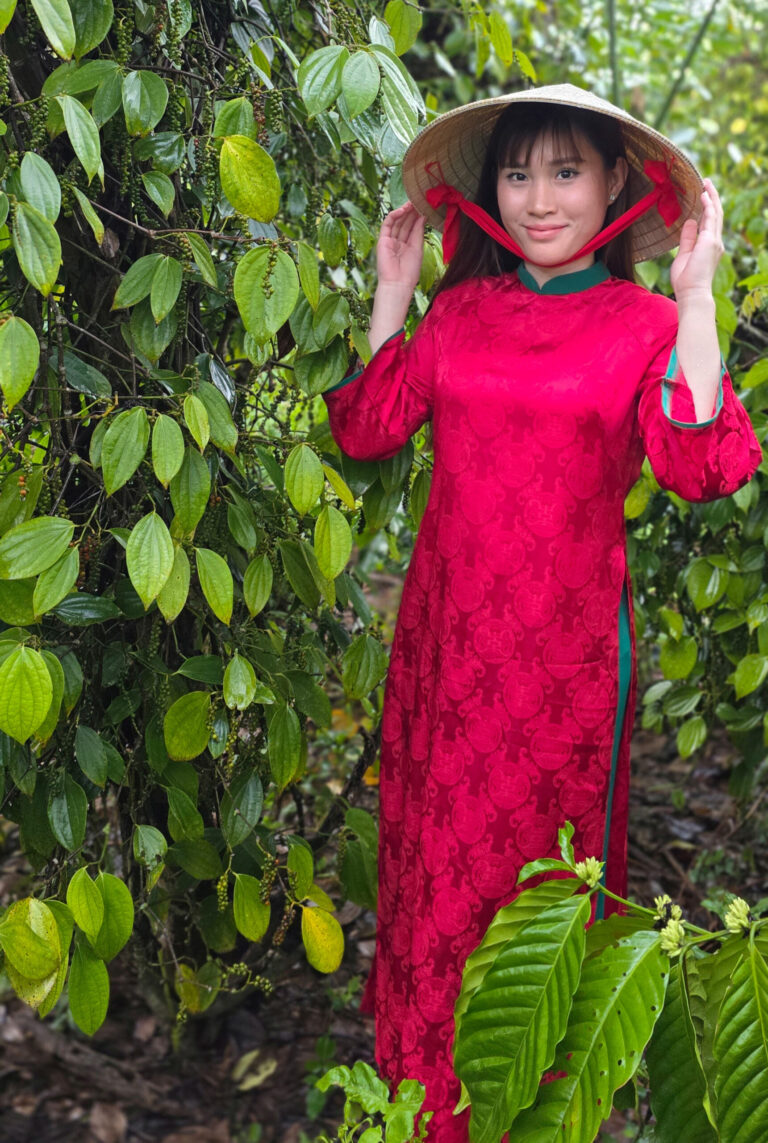
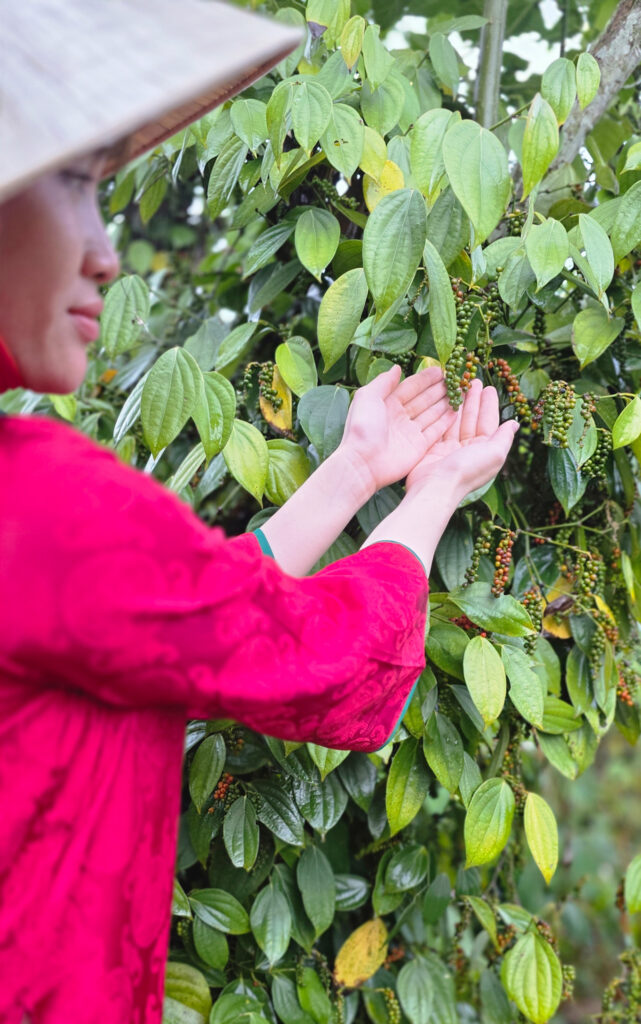
Shown above is my friend, translator, and guide during my visit to pepper farms in Vietnam’s Đắk Lắk region of the Central Highlands of Vietnam. We spent long hours driving the countryside, searching for GPS locations, speaking with farmers, and learning firsthand about the land where these peppercorns are grown. Earlier, we had also visited local production facilities and a cooperative. The photograph from that journey now appear on our Viet Highlands Đắk Lắk Noir™ peppercorn bags.
Many of the farms we visited use intercropping practices, growing coffee and durian alongside pepper vines. This approach helps support natural mulch and fertilizer use while reducing reliance on pesticides. Combined with the region’s volcanic soils, rainfall, and climate, that distinctive terroir helps give Viet Highlands Đắk Lắk Noir™ peppercorns their rich, bold flavor.

Looking for Great Pepper
This photograph was taken in Cambodia in 2025, on a boat passing floating homes deep in the jungle during my search for exceptional peppercorns. For more than 40 years, I have traveled, eaten, and bought spices for my own kitchen. Now I am bringing the best of those discoveries to others.
Viet Highlands Đắk Lắk Noir™ is the first product I have brought to market: whole peppercorns chosen through firsthand travel, tasting, research, and careful sourcing. Order a bag and enjoy the result of that journey.
Welcome. You arrived here by scanning the QR code on a bag of our premium peppercorns. This page provides more information about peppercorns, their origin, and how to reorder.
To purchase again, please order directly through this website using the links below.
AO- Spices Mission
Find the highest-quality spices at their source and deliver them from farm to table for our customers..
Our Values
Viet Highlands Dak Lak Noir
Whole Black Peppercorns
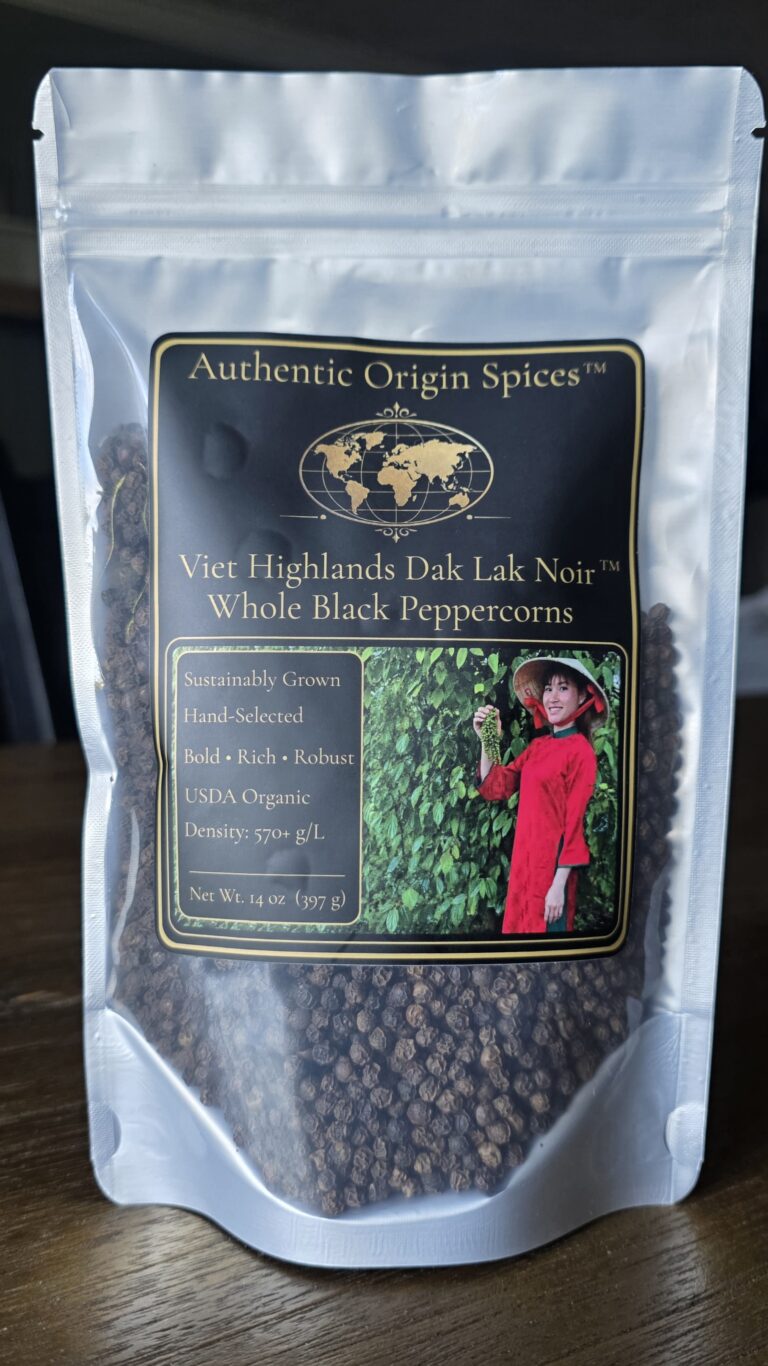
Front of Bag
Hand-picked in Vietnam’s Central Highlands, these USDA Organic Đắk Lắk Noir Peppercorns are sustainably grown in rich volcanic soil and carefully selected for premium 570+ grams per liter density. Naturally rich in piperine and aromatic pepper oils, they deliver bold aroma, robust heat, and complex flavor while complementing a wholesome, well-seasoned meal.
Viet Highlands Dak Lak Noir
Whole Black Peppercorns
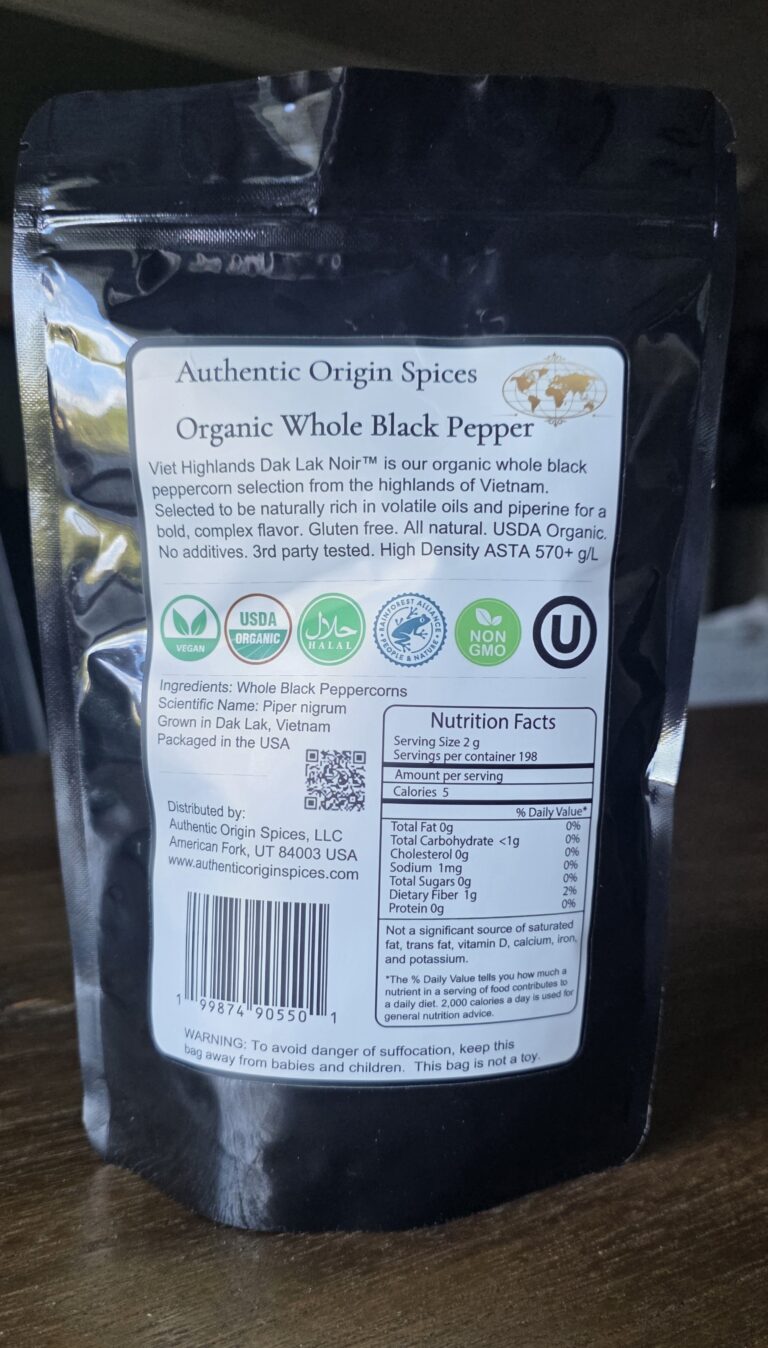
Back of Bag
Whole Black Peppercorns
Back of Bag
Selected to be naturally rich in piperine and aromatic pepper oils, these high-density peppercorns deliver bold flavor, warm spice, and exceptional aroma. Piperine, the natural compound responsible for black pepper’s signature heat, is widely studied for its role in supporting nutrient absorption and antioxidant activity as part of a balanced diet.
Hand-picked from Vietnam’s Central Highlands, a region known for producing some of the world’s finest peppercorns.
Hand-picked in Vietnam’s Central Highlands, where rich volcanic soil, ideal rainfall, and a favorable climate create the perfect conditions for growing some of the world’s finest peppercorns. Cultivated with sustainable and organic farming practices, Highlands Đắk Lắk Noir Peppercorns deliver the bold aroma, depth, and distinctive flavor valued by chefs and home cooks alike.
My Story about going to the Central Highlands of Vietnam and Dak Lak
In the fall of 2025, I visited Vietnam. For years, I had wanted to take a motorcycle journey through the north—from Hanoi toward the Chinese border—along the famous Hà Giang Loop. The Ha Giang Loop winds through some of North Vietnam’s most dramatic mountain country: steep limestone peaks, deep river valleys, terraced fields, small villages, and roads that cling to sheer ridgelines. The landscape feels vast, rugged, and almost unreal—part high alpine wilderness, part centuries-old agricultural countryside.
As I do with most trips like this, I bought a ticket to Hanoi, reserved a hotel for my arrival, and booked a one stay at the end of the trip before my flight home. In this case, that return reservation was about five weeks later. Other than that, I had no fixed itinerary. I left room for the trip to unfold on its own and decided where to go next as opportunities came along.
Keep in mind that this was the fall of 2025. Dak Lak was in 2026, so skip to the end or read on. I had come to Vietnam with several things in mind: I wanted to ride the Hà Giang Loop, visit Angkor Wat in Cambodia, see both Hanoi and Saigon, and mist importantly, explore possible opportunities to source products for import into the United States.
Another reason Vietnam appealed to me was the food—Vietnamese food in particular, but more broadly the flavors of Southeast Asia. I have always enjoyed that kind of cooking, especially when it is made where it comes from rather than adapted for an American audience.
One of the things I discovered early in planning the trip was just how affordable Vietnamese food could be, even at restaurants recognized by Michelin. My previous experience with Michelin restaurants had usually meant spending $250 to $350 per person; before alcohol. In Vietnam, there were many excellent options for a small fraction of that.
In Hanoi, Tầm Vị was Michelin-starred at the time, and you could have a very good meal for around $20. That alone changed the way I thought about dining there. The Tầm Vị experience was memorable for another reason. It was a smaller garden restaurant with limited seating, and as a solo traveler, getting a table for one can sometimes be more difficult than it should be.
I went for lunch without a reservation. I do not remember whether they even took reservations. Just ahead of me was a woman in her mid-twenties who appeared to be there for the same reason: to experience a Michelin restaurant. She was seated first. When I asked for a table, I was told the wait would be around thirty minutes.
I did not want to spend half an hour waiting outside, so I took a chance. I went over to her table and said something like, “I’m an American traveling alone. If you don’t mind, it would be nice to share a meal with someone. Would you be open to that?” To my surprise she enthusiastically and agreed and I joined her.
We decided to study the menu together and order dishes to share—appetizers, entrées, desserts, and drinks. Dining together meant we could share dishes and experience almost twice as many things on the menu.
The service was not particularly good, but the food was excellent. By the time we left, I had not only enjoyed twice the range of dishes I would normally have been able to try, but I had also made a new friend.
She was Israeli and spoke very good English. She also followed Jewish dietary restrictions, which was completely fine with me. In fact, it made the meal more interesting. What could have been an ordinary lunch at a Michelin-starred restaurant became a shared experience with someone I had met only minutes before. One of the pleasures of traveling alone is being open to unplanned experiences—like sharing an excellent meal with a fascinating stranger I never would have met otherwise
Another entertaining part of meeting her was learning how differently we handled travel in Hanoi. She was also traveling alone and regularly used Grab, on the back of a motorcycle Grab is the Southeast Asian ride-hailing app. It often, meant riding on the back of a motorcycle through Hanoi traffic. I used motorcycle Grab only in rare cases because it seemed far too dangerous to me. Oddly, she had no problem with it at all.
She was brave enough to climb onto the back of a stranger’s motorcycle and thread through the city’s chaotic traffic, yet she could not bring herself to cross a busy street on foot. Anyone who has been to Hanoi knows that crosswalks and traffic lights are more suggestion than rule. The way to cross the street, is to step into the street and keep moving at a slow, steady pace. Even in heavy traffic, the motorcycles flow around you. You must not dart, stop, or panic; you simply keep walking, and somehow everyone misses everyone else.
We were supposed to cross the street together, but she backed out every time. Eventually, she simply gave up. I found it hilarious: here was a woman who had served in the Israeli military, carried an automatic weapon, conducted patrols in challenging, high-threat locations—yet Hanoi street traffic was where she drew the line.
She was not the only person who found Hanoi traffic intimidating. Not long afterward, in the same area, I noticed a little girl—probably ten or eleven years old—trying to cross the same busy street. She would step forward, hesitate, and stop again.
I crossed without much trouble, but I could see that she wanted to get to the other side and simply could not force herself do it. So I walked back across the street, motioned for her to come with me, and had her stand on my right while traffic approached from my left. Then we stepped out and crossed at the same slow, steady pace.
It took some nerve for her. She was brave and trusted me. The motorcycles moved around us, just as they were supposed to, and we made it across safely. It was a reminder that even locals do not always feel comfortable navigating Hanoi’s constant stream of motorcycle traffic.
One of my favorite restaurant experiences in Hanoi was at Lamai Garden, which I have referred to as the “the Worm Restaurant” for one of their dishes I enjoyed. I did not realize at the time that the restaurant was listed in the Michelin Guide and had just received a Michelin Green Star —recognition not just for the quality of its food, but for its commitment to sustainability and a farm-to-table approach. It was listed as a Bib Gourmand rather than having a Michelin star, but in my opinion, it was far better than Tầm Vị: better food, better service, and an extraordinary overall tasting menu. It cost about $80 American, which was very expensive by local standards, but still remarkable for the quality of the experience.
Part of what made the Lemai Garden Restaurant so memorable was the garden itself. You entered the small, beautiful restaurant by walking through the garden, and at the end of the meal one of the cooks took me back outside for a short tour. She pointed out the vegetables growing there, explained where they came from, and showed me how they had been used in the dishes I had just eaten. It was an extraordinary ending to an already remarkable meal.
Restaurants with tasting menus can sometimes be easier to experience at lunch or during an early seating, so I made a reservation about two months in advance. Then, about two hours before my reservation, I received a text message asking whether I was still planning to come. Of course I was.
When I arrived, I was the only guest.
I sat at the counter, much like a sushi bar, directly in front of the open kitchen. There were three chefs, several line cooks, and a young woman who brought each course to me and explained what I was eating. She did not have to travel far; I was seated right there at the bar.
One of the chefs was Vietnamese-German and had been trained at a culinary school in Germany. The food was extraordinary. One of the most memorable dishes was made with sandworms—ground together, formed into a ball, and deep-fried. It may not sound especially appealing, but it was fascinating and delicious.
The meal featured all kinds of remarkable food and juices, much of it sourced directly from their own farm and garden. That experience helped me understand something important: great cooking matters, but ingredients matter just as much. Without exceptional ingredients, it is difficult to create exceptional food.
That lesson was reinforced again and again as I traveled and dined through Vietnam and Cambodia. I passed small farms and saw people harvesting by hand, and saw motorcycles piled high with fresh ingredients shipping the day’s produce into the cities, where it would soon become part of someone’s meal.
And finally, this is where pepper becomes part of the story. I had always known that fresh, high-quality ingredients could turn an ordinary meal into something memorable, but it was while eating at Lamai Garden that the truth of it hit me with unusual force.
And that is where Viet Highlands Đắk Lắk Noir Peppercorns belong: bringing bold aroma, depth, and character to everyday cooking and the meals you enjoy most.
After Ha Giang, Sapa, and the day trips from Hanoi, I flew to Siem Reap, Cambodia to see Angkor Wat. (I have only mentioned Siem Reap and Angkor Wat in passing, but each could easily fill hours of stories, history, and detail on its own.)
However, I must mention two of my most memorable meals in Cambodia. One at Embassy in Siem Reap and Sombok in Phnom Penh. Both Embassy and Sombok were led by Chef Kimsan Pol, one of Cambodia’s leading voices in modern Khmer cuisine. Embassy had earned recognition and was included in “50 Best Discovery”, an international guide of expert-recommended restaurants.
Both restaurants were built around a distinctive vision of refined Khmer cuisine led by women. The name Sombok means “nest” in Khmer, a reference to the care, shelter, and nourishment the restaurant hopes to offer its guests. It also reflects its all-woman team of chefs, cooks and staff. It honors the role women have traditionally often played in Khmer households: preparing meals, caring for family, and passing cooking knowledge from one generation to the next.
The Kimsan chefs’ work was showcased at Cambodia Night during the World Economic Forum in Davos, Switzerland, in 2022. At Davos, like at both restaurants, they did not treat Cambodian food as a novelty. Instead, they drew on traditional flavors, local ingredients, and seasonal cooking to create beautifully presented meals that felt deeply rooted in Khmer culture while still thoroughly contemporary.
It was around this time that I began to learn about Cambodian and Vietnamese pepper—their distinct character, their importance in regional cooking, and the way they bring depth to even the simplest dishes.
So, I traveled by bus through the countryside to Phnom Penh, where I confronted the history and horrors of Pol Pot and the evil Khmer Rouge. Another subject I will pass on for now.
Having said that, I have to mention that Pol Pot’s regime is part of the story of Cambodian pepper. Under Khmer Rouge rule, many of Kampot’s pepper plantations were uprooted and replaced with rice fields as part of its disastrous agricultural policies. In the process, Cambodia nearly lost not only a valuable crop, but generations of pepper-growing knowledge and tradition.
It was while learning this part of Cambodia’s history that I became especially interested in pepper production beyond Cambodia, particularly in Vietnam. As I looked more closely, I began to understand the enormous role Vietnam plays in supplying pepper to the world.
I began researching the worldwide industry and quickly realized how difficult it was to get a clear picture from a distance. Then I discovered that an international conference on Vietnam’s pepper industry would be held in Da Nang, early the following spring.
I spent a few days in Ho Chi Minh City—Saigon, as nearly everyone calls it—enjoying more outstanding food, including a meal at Ănăn Saigon, the first restaurant in Ho Chi Minh City to receive a Michelin Star. The restaurant is led by chef-owner Peter Cuong Franklin.
Ănăn means “eat, eat” in Vietnamese. The repetition gives the name an inviting, informal feel—essentially, an enthusiastic “come eat.” The restaurant says the name reflects its location in Chợ Cũ, a busy Saigon wet market, as well as its focus on elevating Vietnamese street food and traditional dishes. The Chef’s 11-course tasting menu Menu is culinary journey from north to south through regional Vietnamese dishes. The tasting menu was one of those meals that builds slowly, course by course, until you realize how completely satisfying it has been.
I had previously planned to travel Northward through central Vietnam—to Da Nang, Hoi An, and Huế, the country’s former imperial capital. But tropical storms had other plans. Severe flooding across much of the Da Nang and Hoi An region made the trip impossible. The storms disrupted flights and delayed my departure from Vietnam by several days, leaving me temporarily stranded.
After the delays, I finally made it back to Hanoi, collected my suits and shirts, enjoyed a few more good meals, and continued learning about the origins of what I consider some of the world’s most distinctive pepper. Then I flew home and began making plans to return for the conference.
In 2026, The official Vietnamese Tet holiday break ran Saturday, February 14 through Sunday, February 22—nine days including weekends.
Shortly after Lunar New Year and Vietnam’s Tết holiday, the conference was held in Da Nang in late February and early March. Over several days, growers, suppliers, exporters, and other industry participants gathered for presentations and discussions on the global pepper market, its challenges, and its future. It was essentially a small trade conference, with displays, networking, and far more firsthand information than I could have found through research alone.
The conference included hours of presentations, panels, and discussions on pepper from Brazil, Vietnam, Indonesia, India, and other producing countries, along with the challenges facing the global industry. Some of the conversation focused on sustainable farming, including the use of pesticides, herbicides, and artificial fertilizers. I learned that there is a growing market for high-end pepper that increasingly favors natural, sustainable production methods and reduced chemical inputs. Although practices can vary widely from one farm to another and it is hard to trust the system.
I also learned about the risks of adulteration, artificial coloring, and other shortcuts used to chase the lowest possible cost. Practices can vary widely by country, supplier, and farm, which made one point especially clear: knowing where peppercorns come from—and being able to trace their path—matters.
I also came away with a much better understanding of the many designations and certifications that can apply to peppercorns and what they are meant to signify.
As part of the program, I joined a sperate tour to Central Highlands.
The Central Highlands are Vietnam’s broad interior uplands: a landscape of volcanic plateaus, forests, rivers, lakes, waterfalls, and farms growing coffee, pepper, and other crops. The region stretches toward both Laos and Cambodia. Đắk Lắk lies farther south, closer to Cambodia.
The conference tour group flew from Da Nang to Buôn Ma Thuột. We visited farms and cooperatives, as well as both small and large processing facilities, where we learned firsthand how peppercorns are cleaned, sorted, and prepared for export. I also rented a car/driver and with my translator visited farms and spent time talking with the farmers themselves. It was an extraordinary experience in the beautiful Central Highlands of Đắk Lắk.
Đắk Lắk has a terroir especially well suited to exceptional peppercorns: rich red basalt soils, a warm tropical highland climate, reliable seasonal rains, and a distinct dry season. Together, these conditions give the vines what they need to thrive and help produce pepper with deep aroma, lively heat, and real complexity.
After the tour, I stayed for a few days longer and traveled through the Đắk Lắk region, continuing south to Đà Lạt. Along the way, I talked with people, learned as much as I could about pepper, and tasted a remarkable range of pepper.
The discussions also covered sustainable farming, including the use of pesticides, herbicides, and artificial fertilizers. I uncovered the growing market for high-end pepper that increasingly favors natural, sustainable production methods and reduced chemical inputs. I also came away with a much better understanding of the many designations and certifications that can apply to peppercorns and what they are meant to signify.
I spent hours driving through the region with maps and dropped pins I had been given, trying to locate specific farms and see the work firsthand.
After days at the conference, time in the Central Highlands, and my own additional research, I found a unique area and small trustworthy supplier. The peppercorns stand out for their quality and character, and I chose to bring them forward under the name Viet Highlands Đắk Lắk Noir.

“Authentic Origin Spices has an amazing team of hard working professionals. It has been a pleasure to work with them to buy amazing quality spices.

Emily Davis